
Yes. Mimi’s Miracle Zeolites is tested by independent outside laboratories. Not by us, and not by the company that makes it for us.
The labs test the finished bottled liquid, lot by lot, for two separate things: a microbial safety panel, and a heavy-metal panel for lead, arsenic, cadmium and mercury measured by ICP-MS. And Mimi’s Miracle Zeolites is made in a GMP-certified facility in the USA.
Quick answer: Every production lot of Mimi’s Miracle Zeolites gets its own certificate of analysis from an independent laboratory. The testing covers microbial safety (E. coli, Salmonella, Staph aureus, yeast and mold) and the four heavy metals that matter most in a mineral supplement, lead, arsenic, cadmium and mercury, measured by ICP-MS on the finished liquid, not on the raw mineral. On the most recently tested lot, lead and arsenic came in at roughly one percent of the program’s allowable limit, and cadmium and mercury were below the laboratory’s detection threshold.
Below are the real numbers, plus how to read a lab claim on any supplement bottle.
Why testing matters more for a zeolite than for most supplements
Clinoptilolite zeolite is a naturally occurring volcanic mineral with a negatively charged, cage-like structure. That structure attracts and holds positively charged particles.
It’s the whole reason zeolite shows up in detox-support formulas in the first place.
It’s also why the testing question deserves a real answer instead of a reassuring adjective. A mineral mined out of the ground can carry trace metals from its own deposit.
supplement products were screened for heavy metals by ICP-MS in one market survey. Formulation type, dosage form and country of origin all predicted how much a product carried.Source: Heavy metal contamination of dietary supplement products, Scientific Reports, 2020
And heavy metals in supplements aren’t a hypothetical worry.
Most products in that survey were well within acceptable daily intake levels. The point is that the amount varies by product, which is exactly why the individual product has to be measured.
There’s a second reason the finished liquid gets tested, not the raw ore. A clean source deposit doesn’t promise a clean finished bottle.
tested the same lot a few weeks apart and got 0.091 and 0.089 parts per million of lead. Landing within a rounding error of each other is what good testing looks like.Source: Mimi’s Miracle Zeolites certificates of analysis, Analytical Resource Laboratories (Dec 2025) and Eurofins (Jan 2026)
Anything introduced during milling, formulating or bottling would be invisible in a test of the raw material. The certificate of analysis describes what’s actually in the bottle you swallow from.
What “third-party tested” means here, specifically
The phrase gets used loosely, so here’s the precise version.
Outside labs, no stake in the answer. Testing is done by contract laboratories with no ownership tie to Dirobi or to the manufacturer. That’s the actual definition of a third party.
| Metal | Result per serving | Limit | Outcome |
|---|---|---|---|
| Lead | 0.000089 mg | 0.01 mg | Pass |
| Arsenic | 0.000090 mg | 0.01 mg | Pass |
| Cadmium | Below detection | 0.0041 mg | Pass |
| Mercury | Below detection | 0.002 mg | Pass |
More than one lab has been used across production runs, including one accredited to ISO/IEC 17025:2017, the international standard for testing-lab competence.
Every lot, not once at launch. Each production run carries its own certificate tied to that specific batch. A certificate from 2025 doesn’t stand in for a batch made in 2026.
Two labs, one lot, same answer. One lot from late 2025 shows why this matters. It was tested by two different labs a few weeks apart.

What the most recent results actually show
On the most recently tested lot, the heavy-metal panel was run by ICP-MS on the finished liquid and reported per one-milliliter serving, against the testing program’s limits:
Earlier lots tested at other labs came back in the same range, written in parts per million: lead in the low tenths, arsenic in the hundredths, cadmium and mercury at or near the detection floor.
of the allowable limit: that’s where lead and arsenic landed on the latest lot. Cadmium and mercury didn’t show up at all.Source: Eurofins certificate of analysis for Mimi’s Miracle Zeolites, January 2026, per 1 mL serving
The microbial panel on that same lot passed too. E. coli, Salmonella, Staph aureus and Pseudomonas were all absent, and yeast, mold and total plate counts were below reporting limits.
The same run also screened for adulterants and banned substances, and none were detected. That’s the paperwork behind every bottle of Mimi’s Miracle Zeolites.
Testing and manufacturing standards are two different things
These two get mashed together constantly in supplement marketing. The difference changes what a claim is actually worth to you.
GMP is about process. Good Manufacturing Practice is a set of rules for how a product is made.
For supplements sold in the US, cGMP is a federal regulation, 21 CFR Part 111, covering how ingredients are received, identity-tested, blended, packaged and documented.
It applies by law to any company making supplements for the US market. Mimi’s Miracle Zeolites is made in the USA in a GMP-certified facility.
“Made to the highest standards” on a label means the product was tested.
That’s a description of intent. “Here’s the batch, here’s the lab, here are the numbers” is a result. You want both a good process and a lab report.
A certificate of analysis is about one batch. It isn’t a process rule. It’s a measurement of one specific batch, taken after that batch exists, by someone with no stake in the answer.
Good process makes a clean result likely. Only a lab report shows it.
A product with one and not the other is showing you half the picture, and the half that gets advertised is usually the vaguer one.
4 questions to ask about any “lab tested” supplement
- Who ran the test? An outside lab with no ownership tie to the brand, ideally one accredited to ISO/IEC 17025.
- What got tested? The finished product you swallow, not only the raw ingredient.
- Which batch? A certificate should match a lot number, not be one test from launch day.
- For what? Look for heavy metals (lead, arsenic, cadmium, mercury) and a microbial panel, with actual numbers.
How to take it
The label directs 20 drops morning and night. Take it under the tongue or stir it into a drink.
If you also take Mimi’s Miracle Minerals, here’s how the two work together. And if you take medication, read can zeolite be taken with medications first, and check with your doctor or pharmacist.
The bottom line
Mimi’s Miracle Zeolites is third-party tested, batch by batch, by outside labs, on the finished liquid, for both microbial safety and the four heavy metals that matter in a mineral supplement.

It’s made in a GMP-certified facility in the USA. For a mineral known for holding onto charged particles, that’s not a nice-to-have detail.
It’s the proof that the thing you’re taking isn’t quietly adding to the problem.
If you’ve been waiting for numbers before trying a zeolite, now you have them. Take a look at Mimi’s Miracle Zeolites.
Proof in every bottle
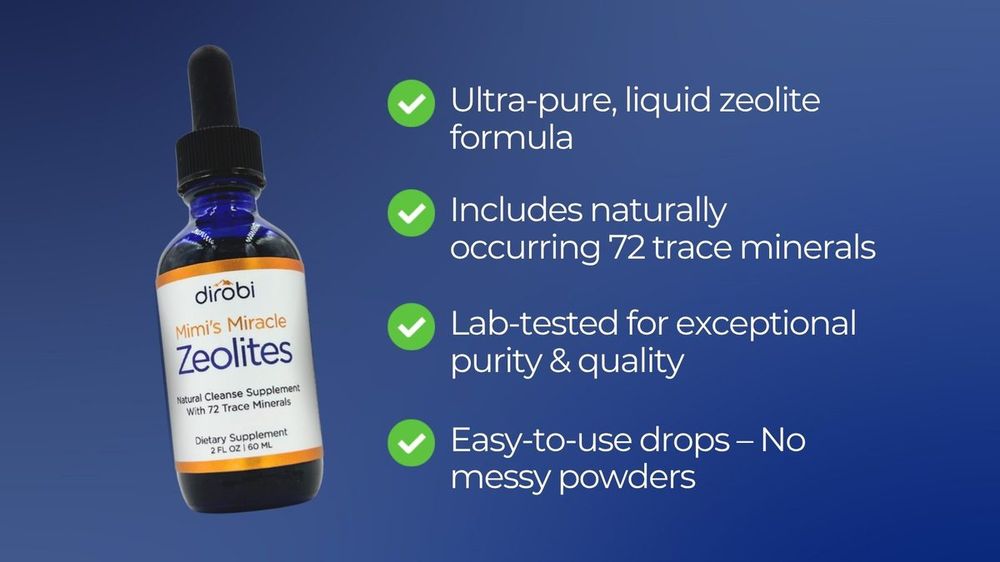
Mimi’s Miracle Zeolites is a liquid clinoptilolite zeolite, tested by outside labs lot by lot.

- ✓Independent lab testing on every production lot
- ✓Heavy-metal panel by ICP-MS, plus microbial safety
- ✓Made in the USA in a GMP-certified facility
- ✓Easy drops, under the tongue or in any drink
Common questions
Who tests Mimi’s Miracle Zeolites?
Independent contract laboratories with no ownership relationship to Dirobi or its manufacturer, which is what makes the testing genuinely third-party. More than one lab has been used across production runs, including a laboratory accredited to ISO/IEC 17025:2017, the international standard for testing-laboratory competence.
Which heavy metals are tested, specifically?
Lead, arsenic, cadmium and mercury, each measured by ICP-MS. These are the four elements treated as the primary toxicological concerns in finished dietary supplements, including in USP’s elemental contaminants chapter for dietary supplements, USP 2232.
Is every batch tested, or just one sample formula?
Every production lot carries its own certificate of analysis tied to that specific batch number. It is not a single test run at launch and then reused indefinitely, which is why a current certificate refers to a current batch.
Is the raw zeolite tested, or the finished bottled liquid?
The finished, formulated liquid is what carries the certificate of analysis, because that is what actually gets consumed. Testing the raw mineral alone would not catch anything introduced during processing or bottling.
What is the difference between third-party tested and GMP?
They are two different safeguards. GMP, or Current Good Manufacturing Practice, is a federal process regulation (21 CFR Part 111) covering how a supplement is made and documented, and it applies by law to U.S. manufacturers. A third-party certificate of analysis is a measurement of a specific finished batch by an outside laboratory. Good process makes a clean result likely; only the lab report demonstrates it for a given lot. Mimi’s Miracle Zeolites has both: it is made in a GMP-certified facility and every lot carries its own certificate of analysis.
Can I see the certificate of analysis for my bottle?
Certificates are issued per production lot, so the relevant one depends on which batch you have. Contact Dirobi at 1-888-665-7769 or through the site with the lot number printed on your bottle.
Related reading: Zeolite clinoptilolite explained · Liquid zeolites and your body’s detox pathways · How zeolite and trace minerals work together
By Dave Sherwin, PN1 Certified Nutrition Coach
