
Related reading: What Are the 90 Essential Nutrients? (And Why 60 of Them Are Minerals) · Fulvic Acid and Nutrient Cravings
Your body needs some minerals by the scoop and a whole crew of others by the pinch. The pinch crew are the trace minerals: zinc, selenium, iodine, copper, iron, manganese and friends.
You need them in amounts so small they’re measured in milligrams and micrograms. And yet without them, a surprising amount of your everyday chemistry sits in the driveway with the engine off.
Quick answer: Trace minerals are essential minerals your body needs in small amounts, generally less than 100 milligrams a day. The main ones are iron, zinc, copper, manganese, iodine, selenium, molybdenum and chromium. They help enzymes do their jobs, carry oxygen through your blood, build thyroid hormone and power your body’s own antioxidant enzymes. Your body can’t make any of them, so they have to come from food, water or a supplement such as Mimi’s Miracle Minerals, which delivers 70+ ionic trace minerals in a fulvic and humic acid base.
They’re also the reason we make Mimi’s Miracle Minerals.
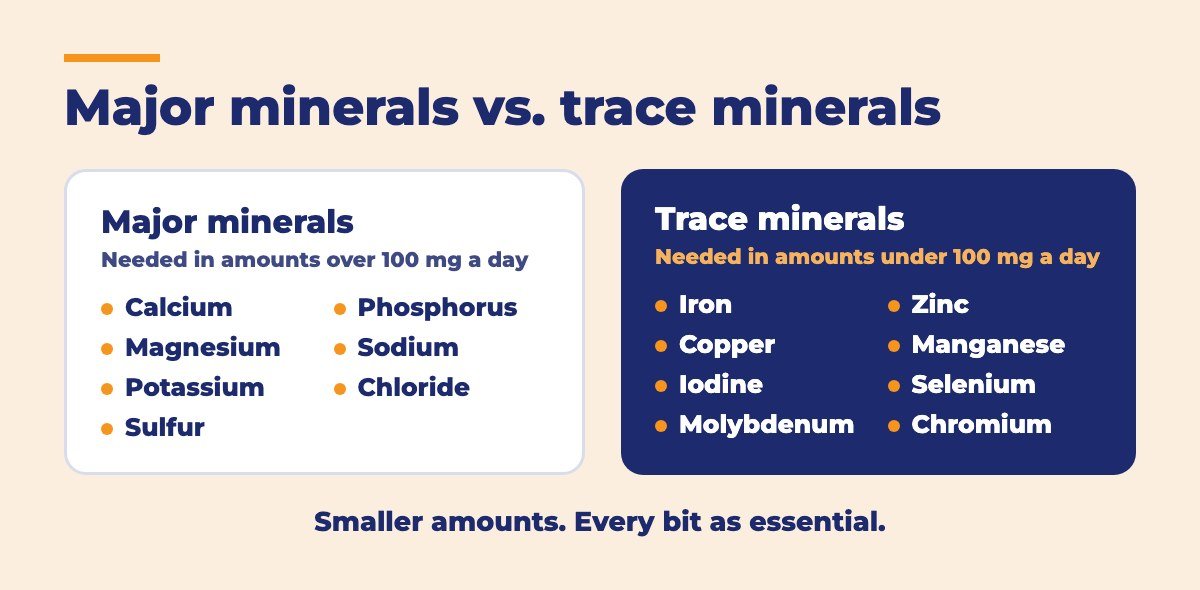
Trace minerals vs. major minerals: it’s the dose, not the importance
Nutrition science sorts the essential minerals into two groups. The dividing line is simply how much of each one you need.
Major minerals (macrominerals) are needed at more than 100 milligrams a day, often a lot more.
Calcium, phosphorus, magnesium, sodium, potassium, chloride and sulfur do the heavy structural and electrical work: building bone, balancing fluids, firing nerves. Big jobs, big numbers.
of selenium can be packed into a single ounce of Brazil nuts, about six to eight nuts. The adult daily need is 55 mcg. One nut can cover the whole day.Source: NIH Office of Dietary Supplements, Selenium Fact Sheet for Health Professionals
Trace minerals (microminerals) are needed at less than 100 milligrams a day, and a few only in micrograms, which are millionths of a gram. Small dose. Same importance.
How small is small? Here’s selenium, one of the pinch crew.
What trace minerals actually do all day
The tiny dose hides a big workload. Most trace minerals work as cofactors, the small parts an enzyme needs clipped into place before it can do its job.
Think of your car key. Small, easy to lose, and the whole car goes nowhere without it.
Here’s the part that matters most: your body can’t make a single one of these. Minerals are elements.
| Mineral | Its day job |
|---|---|
| Iron | Sits at the center of hemoglobin, the protein that carries oxygen from your lungs to every cell you own. |
| Zinc | Helps more than a hundred enzymes do their work, from how your food tastes to how a paper cut heals. |
| Selenium | Built into the proteins that help make active thyroid hormone, and into the glutathione peroxidase enzymes behind your body’s own antioxidant defenses. |
| Iodine | The raw material for thyroid hormone. No iodine, no hormone, the same way no flour means no bread. |
| Copper | Helps your body use iron, and is part of the machinery your cells use to make energy. |
| Manganese | Supports normal bone formation and a key antioxidant enzyme inside your mitochondria. |
| Molybdenum | The least famous name on the list. A cofactor for enzymes that process certain amino acids. |
Every bit of them has to come in through what you eat, what you drink or what you take. A daily source like Mimi’s Miracle Minerals keeps that supply line steady.
Where trace minerals quietly go missing
A plate can look perfect and still come up a little light. Three reasons, and none of them are your fault.
The produce has changed. A 2004 analysis in the Journal of the American College of Nutrition compared USDA nutrient data for 43 garden crops between 1950 and 1999.
drops in the median levels of six nutrients, including calcium, phosphorus and iron, across 43 garden crops between 1950 and 1999.Source: Davis, Epp and Riordan, Journal of the American College of Nutrition, 2004
It found measurable declines in several nutrients, including calcium, phosphorus and iron. The researchers pointed mostly to modern varieties bred for size and yield.
Bigger harvests, with the minerals spread a little thinner.
Refining strips them out. Turning whole grains into white flour removes the bran and the germ, and that’s where much of a grain’s mineral content lives. The fluffy bread isn’t lying to you, exactly.
It’s just leaving things out.
“I add these drops to remineralize my water due to intense filtering. They give me what I need, highly recommend !”
— Mia Gagnon, Wembley, AB · Verified Buyer · Read more reviews
Filtered water skips them. Reverse osmosis and other heavy filtration take dissolved minerals out along with everything you wanted gone. Great for taste.
One of our customers noticed the gap and did something about it.
If you sweat a lot, minerals are part of your hydration story too. We cover that side in you’re probably low on electrolytes and the best electrolyte drink mix.

How to get more trace minerals every day
Food first. Always. Then fill the gaps.
Then there’s the easy button. A liquid trace mineral supplement covers the whole spectrum in one step, so you’re not tracking eight minerals on a spreadsheet at breakfast.
That’s exactly the job Mimi’s Miracle Minerals was built for.
Why ionic, plant-derived trace minerals are different
Not every mineral supplement is built the same way. Many low-cost tablets use mineral salts such as zinc oxide or ferrous sulfate, which your body has to break apart before it can use them.
5 easy places to find trace minerals
- Seafood and shellfish for zinc, selenium and iodine.
- Nuts and seeds, especially Brazil nuts for selenium and pumpkin seeds for zinc.
- Whole grains, beans and lentils for iron, manganese and molybdenum.
- Dark leafy greens for iron and manganese.
- Eggs for selenium and iodine.
Ionic trace minerals are minerals already dissolved in their charged, elemental form, the form minerals take in solution. Mimi’s Miracle Minerals goes a step further.
Its minerals come naturally bound to fulvic and humic acid from ancient plant deposits in the USA.
Fulvic acid is a small organic molecule that forms in rich soil and binds minerals readily, which is why it has such a long history as a mineral carrier.

Want the deeper dive? We cover fulvic acid and the benefits of humic acid in their own posts.
How to take liquid trace minerals (and a word about your shirt)
Follow the label: 1 mL, about 20 drops, morning and night. Add it to non-chlorinated water or juice, or put it straight in your mouth and swallow.
Two things surprise new customers. First, it’s dark, roughly the color of strong tea, and it has almost no taste.
Second, the label means it when it says this product will stain clothes. Drop it over the sink, not over the white shirt you’re wearing to lunch.

If you also take Mimi’s Miracle Zeolites, the two are designed as a pair: one clears, one replenishes. How zeolite and trace minerals work together walks through the morning and evening timing.
Pregnant, nursing, taking prescription medication or managing a health condition? Check with your healthcare professional before adding any new supplement. The label says the same thing.
The bottom line
Trace minerals are the smallest line items on your nutrition label and some of the hardest-working.
If a little is good, a lot of minerals must be better.
With minerals, more is not better. Adults need only micrograms of some of them. Follow the serving size on your label.
Iron moves oxygen, zinc keeps a hundred-plus enzymes on the clock, and selenium and iodine keep your thyroid in business.
Your body can’t make any of them, so they need to come in every day.
Eat the seafood, the seeds and the greens. Then close the gaps with Mimi’s Miracle Minerals, twenty drops at a time.
Your daily trace minerals, in twenty drops
A fulvic and humic acid trace mineral supplement you can take straight or add to water, juice or a smoothie.

- ✓70+ ionic trace minerals
- ✓Fulvic and humic acid from ancient plant deposits in the USA
- ✓Nearly tasteless, with no pills and no powders
- ✓Vegan and non-GMO, made in the USA, packed in glass
Common questions
What are trace minerals?
Trace minerals are essential minerals your body needs in small amounts, generally under 100 milligrams a day. The main ones are iron, zinc, copper, manganese, iodine, selenium, molybdenum and chromium. Your body cannot make them, so they have to come from food, water or a supplement like Mimi’s Miracle Minerals.
What is the difference between major minerals and trace minerals?
The amount you need. Major minerals such as calcium, magnesium, potassium and sodium are needed in amounts over 100 milligrams a day. Trace minerals such as zinc, selenium, iodine and copper are needed in amounts under 100 milligrams a day, some only in micrograms. Both groups are essential.
What do trace minerals do in the body?
Most of them act as cofactors that switch enzymes on. Iron carries oxygen in hemoglobin, zinc helps more than a hundred enzymes work, iodine and selenium are both needed to make and activate thyroid hormone, and selenium, copper and manganese are part of the body’s own antioxidant enzymes.
What foods are high in trace minerals?
Seafood and shellfish, Brazil nuts, pumpkin seeds, whole grains, beans, lentils, dark leafy greens and eggs are among the richest sources. A liquid trace mineral supplement is an easy way to cover the full spectrum.
What are ionic trace minerals?
Ionic trace minerals are minerals dissolved in their charged, elemental form rather than locked in a mineral salt the body has to break down first. The minerals in Mimi’s Miracle Minerals come bound to fulvic and humic acid from ancient plant deposits.
How much of each trace mineral do you need?
Very little. Adults need about 55 micrograms of selenium a day, 8 to 11 milligrams of zinc, and 8 to 18 milligrams of iron depending on age and sex. With minerals, more is not better, so follow the serving size on your supplement label.
Are trace minerals the same as electrolytes?
Not quite. Electrolytes are minerals that carry an electrical charge in body fluids, mostly major minerals such as sodium, potassium, chloride and magnesium. Trace minerals are needed in much smaller amounts and mostly work as enzyme cofactors.
Sources: Davis DR, Epp MD, Riordan HD. Changes in USDA food composition data for 43 garden crops, 1950 to 1999.
Journal of the American College of Nutrition, 2004. National Institutes of Health Office of Dietary Supplements, fact sheets for zinc, selenium, iodine and iron.
By Dave Sherwin, PN1 Certified Nutrition Coach
