
You bought a digestive enzyme, you swallowed it, and now you’re sitting there like someone who just pressed the elevator button. Is it working yet? How about now? Now?
Good news. With enzymes, the waiting is mostly optional.
Quick answer: Digestive enzymes start working as soon as they meet your food, so the clock starts at your first bite, not at the moment you swallow the capsule. Take them just before or with the meal (up to about 20 minutes before is the usual window). The difference people look for shows up over the next few hours, the stretch where gas, heaviness or bloating would normally arrive. Probiotic ingredients are different: they work on a timeline of weeks of daily use, not a single meal. That’s why Eat Anything Rx is taken with the first bite.
What decides whether they work isn’t how long you wait. It’s when you take them.
Flip the hourglass at the first bite of spaghetti, not an hour after it.
Enzymes don’t “kick in.” They clock in.
Most supplements have to be absorbed and carried around the body before they do anything. That’s why “give it a few weeks” is the standard advice.
Digestive enzymes work differently. They’re tools for taking food apart, and a tool only works when it’s touching the job. Amylase, protease, lipase and cellulase go after the starch, protein, fat and plant fiber in your meal.
| When | What’s happening |
|---|---|
| Up to ~20 minutes before, or at the first bite | You take the capsule. This is the part you control, and it matters most. |
| During the meal | The capsule opens and the enzymes mix with the food as it arrives. They have to make it through stomach acid to keep working, which is why the formula matters. |
| The next few hours | Food moves on into the small intestine, where most breakdown and absorption happens. Anything left undigested keeps going to the colon, where gut bacteria ferment it into gas. |
| 30 minutes to about 4 hours after eating | Your observation window. It’s when the usual trouble shows up: fructose-type reactions tend to arrive earlier, bean-and-broccoli gas tends to arrive later, often two to four hours in. |
They do it in your stomach and small intestine, alongside the food, while the food is there.
Think of a kitchen crew. Show up with the groceries and they start chopping.
Show up three hours after the groceries went by and they’re standing in an empty kitchen holding knives, which is unhelpful and a little unsettling.
That’s the whole timing secret. There’s no warm-up period to wait out. There’s a window to hit.
is the checkpoint on the standard hospital stomach-emptying test. If more than 10% of the test meal is still in the stomach at four hours, emptying counts as slow. In other words, a meal is a multi-hour event, and your enzymes need to be there from the opening act.Source: Abell et al., consensus recommendations for gastric emptying scintigraphy, American Journal of Gastroenterology, 2008
The timeline, meal by meal
Here’s roughly what happens when you take an enzyme blend with a meal, and when you’d expect to notice anything.
So the honest answer to “how long does it take?” is this: the enzymes start right away, and you find out over the next few hours, by noticing what doesn’t happen.
That last part trips people up. A digestive enzyme doesn’t give you a buzz.
The win is quieter: the waistband you didn’t have to unbutton, the afternoon that didn’t go heavy and sluggish, the bathroom trip you didn’t have to plan around.
American adults had dealt with bloating in just the past week. If you’re checking the clock after dinner, you’ve got plenty of company.Source: survey of 71,812 US adults, Almario et al., American Journal of Gastroenterology, 2018 (20.6%)
It’s why Eat Anything Rx is judged by a quiet evening, not a feeling in the first five minutes.

What the research shows about timing
The best studies on the specialty enzymes are built exactly the way you’d use them: enzyme and trigger food together, then watch the next few hours.
- Xylose isomerase (the fructose enzyme). In a 2012 double-blind, placebo-controlled study (Komericki and colleagues, Alimentary Pharmacology & Therapeutics), 65 people with fructose malabsorption drank 25 grams of fructose with either xylose isomerase or a placebo. With the enzyme, breath hydrogen, a marker of fermenting sugar, was markedly lower, and abdominal pain and nausea scores were lower too, measured in the hours right after.
- Alpha-galactosidase (the bean and broccoli enzyme). A 2007 double-blind study (Di Stefano and colleagues, Digestive Diseases and Sciences) gave it with a big serving of beans and found less breath hydrogen and less severe flatulence afterward. It works on the sugars that make beans famously musical, and only if it’s there when the beans are.
Digestive enzymes need a few weeks to build up before they work.
Enzymes work meal by meal, starting when they meet your food. It’s the probiotic side of a blend that builds with weeks of daily use.
Both are research on individual ingredients, not on any finished product, and neither is a promise about how any one person will feel.
But they make the timing point clearly: enzyme with the meal, effect measured in hours, not weeks.
What about the probiotic part?
Eat Anything Rx also carries Lacto-Wise, a probiotic and prebiotic pairing. That half runs on a completely different clock.
Probiotics aren’t tools that act on one meal. They’re more like new neighbors settling in, and that takes consistent daily use over weeks.
“I take two of these about 20 minutes before I eat something I know would otherwise kill my stomach, and boom. Nothing bad happens.”
— Briana Milhoan, Amazon Verified Purchase · Read more reviews
The published study on the finished Lacto-Wise ingredient, for example, ran for three months of daily use.
We cover that side in probiotics for digestive health, and the difference between the two in digestive enzymes vs. probiotics.
Which gives you a tidy way to think about a four-in-one capsule: the enzymes work meal by meal, and the synbiotic builds with every day you stay consistent.
“I took it and nothing happened.” Check these four things.
When someone tells us an enzyme didn’t seem to work, it’s usually one of these, and most are fixable at the very next meal.
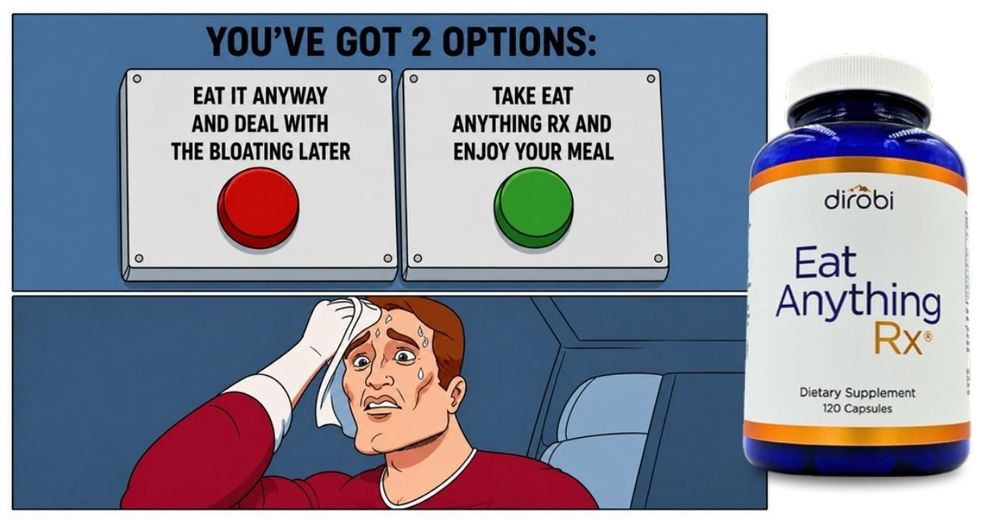
1. It was taken too late
Taking it after the meal, or “when the bloating starts,” is the most common miss. By then the food has moved on without its crew.
Take it right before or with the first bite.
2. It was taken too early
An hour before dinner is too early. The usual window is up to about 20 minutes before eating, or during the meal.
3. The dose didn’t match the meal
A light lunch and a holiday plate aren’t the same job. The label direction is one to two capsules before each meal, and we suggest starting with two, then finding your number.
How to test an enzyme fairly (no lab coat required)
- Pick your usual troublemaker. The apple, the chili, the pasta night, the restaurant meal.
- Take two capsules right before your first bite.
- Eat the meal the way you normally would. This isn’t the time to also cut your portion in half, or you won’t know which change helped.
- Check in over the next few hours. Note how you feel at about one hour and again around three.
- Repeat it a few times. One meal is an anecdote. Three or four similar meals start to look like a pattern.
A big, rich or fructose-heavy meal is a two-capsule meal.
4. The enzyme didn’t match the food
Enzymes are specific. The APLC blend covers starch, protein, fat and fiber, xylose isomerase handles fructose, and alpha-galactosidase handles beans and cruciferous vegetables.
A blend without the right enzyme for your trigger food won’t do much for it, however long you wait.

The bottom line
Digestive enzymes don’t need weeks to build up.
They start working when they meet your food, which makes timing the whole game: take them just before or with your first bite, match the dose to the meal, and judge them over the next few hours by what doesn’t happen.
If a certain meal keeps getting the better of you, Eat Anything Rx is the blend we built for it. Run the test on that exact meal this week.
And if your trouble is broader than one meal and you keep feeling full after just a few bites, that’s worth a read too, and worth a conversation with your doctor.
Take it with your next meal
Eat Anything Rx clocks in with your meal and works on what’s on the plate, which is exactly the timing this whole article is about.

- ✓APLC blend: amylase, protease, lipase and cellulase
- ✓Xylose isomerase for fructose
- ✓Alpha-galactosidase for beans and broccoli
- ✓Lacto-Wise probiotic and prebiotic for the long game
Common questions
How long does it take for digestive enzymes to work?
They start working as soon as they meet your food, so the clock starts at your first bite. The effect people notice shows up over the next few hours, the window where gas, heaviness or bloating would normally appear. Taking them at the right moment matters far more than waiting.
Should I take digestive enzymes before or after a meal?
Before or with the meal. The usual window is up to about 20 minutes before eating, or with the first few bites. After the meal is too late for the enzymes to meet the food they are built to break down. Eat Anything Rx is directed as one to two capsules before each meal.
Can I take a digestive enzyme once bloating has already started?
It is unlikely to help much at that point. Bloating after a meal usually comes from gas produced by gut bacteria fermenting food that was not fully broken down earlier. Enzymes work upstream of that, on the food itself, so the next meal is the one to plan for.
Do I need to take digestive enzymes for weeks before they work?
Not the enzymes. They work meal by meal. Probiotic ingredients, like the Lacto-Wise pairing in Eat Anything Rx, are different and build with consistent daily use over weeks.
How many capsules should I take?
Follow the label. For Eat Anything Rx that is one to two capsules before each meal. Start with two, then find your number: lighter meals often need one, and big, rich or fructose-heavy meals are two-capsule meals.
Do digestive enzymes survive stomach acid?
It depends on the enzyme and the formula, and it is one of the most common questions about enzymes. We cover it in detail in do digestive enzymes survive stomach acid.
Will Eat Anything Rx help with dairy?
It supports the protein and fat side of dairy. Its APLC blend includes protease for milk protein and lipase for milk fat, which helps with dairy-rich meals like a cheesy pasta or a cream sauce.
By Dave Sherwin, PN1 Certified Nutrition Coach
